You can be excellent at what you do and still have a website that feels underpowered or ineffective. If you have years of experience, happy clients, strong results, testimonials, case studies, and media features, but your site still isn't converting, that's often pointing to a proof problem.
For established service providers, this is one of the most common credibility leaks I see. Your website social proof may exist, but if it isn't visible and repeated in the right places, visitors won't feel the trust you're hoping to build.
What You'll Learn in This Article
Prefer to watch instead of read? My YouTube video covers everything in this post. Otherwise, keep scrolling for the full written breakdown.
When your expertise and your website don't match
I call this the credibility gap— the distance between your real-world expertise and the way your website represents you online.
That gap can show up in four areas: clarity, proof, path, and presence. If you want the wider context on all four, this post on 4 credibility leaks to fix covers the full picture. Here, the focus is on proof, because it's one of the easiest leaks to miss when you're already established and highly qualified.
Proof is what helps a stranger believe you. Your website can say you're experienced, trusted, and effective, but proof is what backs that up. It turns your claims into something solid.
That matters because visitors usually don't arrive ready to trust you. They land on your homepage or services page with limited time, limited context, and some level of caution. They're deciding whether your site feels credible enough to keep reading, and whether you feel trustworthy enough to contact.
When proof is missing, buried, or too thin, even a strong business can look uncertain. That's where website social proof does its best work. It closes the space between "this sounds good" and "I believe this."
What counts as proof on your website
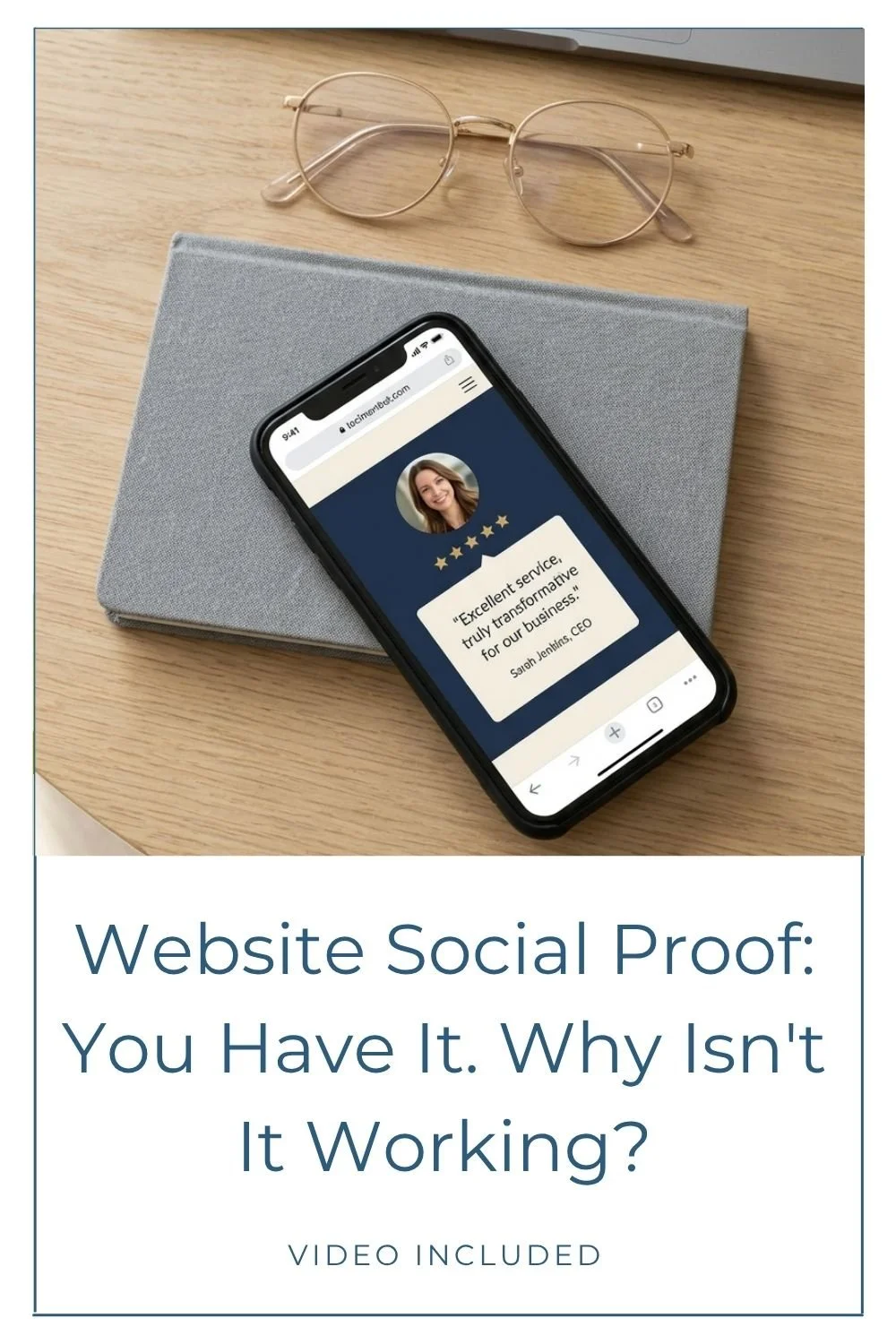
The social proof on your website is the evidence that supports what you say about yourself and your work. It gives people something concrete to hold onto, especially if they don't know you yet. That can take a lot of forms: testimonials, client results, case studies, credentials or licensing, media mentions like TV appearances, magazine features, or podcast spots, and awards.
Each of these pieces helps show that your expertise is real and earned. They support your claims instead of asking visitors to take your word for it.
This kind of website social proof matters most for women who have been in business for years and already have a body of work behind them. If you've built a track record, your site should show it clearly.
One quick note:if you're newer in business and working with one testimonial or one project in your portfolio, that's a different situation entirely. You're building from where you are, and that's completely fine. This post is for business owners who already have proof available but aren't using it well on their websites. It's not about having a massive library of evidence. It's about making good use of what's already there.
The two ways your proof is failing to build trust
A proof problem usually shows up in one of two ways. Either the proof is there but hard to find, or it appears too rarely to build real trust. Both issues can undermine your site in ways that are easy to miss. You may technically have testimonials, case studies, and credibility markers somewhere on the page, but if visitors don't encounter them at the right moments, they don't do much work.
When proof exists but has no prominence
The first problem is prominence, or the lack of it.
Your proof may already be on your site, but people have to hunt for it. It might be tucked near the bottom of your homepage, or living only on a dedicated testimonials page that most visitors never look at. Sometimes it's placed on an About page that doesn't get much traffic. In other cases, it appears once and then disappears entirely.
Visitors aren’t arriving at your site planning to be private investigators. They're not going to, and don’t want to, dig through multiple pages to find evidence that you're credible, skilled, and trustworthy. That proof needs to appear directly in their path.
If someone moves through your homepage or services page without seeing clear evidence of results, experience, or client trust, your proof is functionally invisible. It may be technically present, but it isn't doing its job.
This is where a lot of website social proof falls short. Business owners gather it, save it, and even upload it, but they place it too far down the page or isolate it in one low-traffic section. Meanwhile, the places where decisions are actually being made stay thin on trust-building detail.
Proof needs to show up where people are already looking, which usually means key sections on your homepage and your main services page, not just a page visitors may never open.
When proof appears too rarely to build trust
The second problem is frequency.
A single testimonial on your homepage isn't much. One case study in your portfolio isn't much either. A lone quote in the footer doesn't create a pattern.
Trust builds through repetition. Each time a visitor sees evidence that you've helped real people get real results, their confidence rises a little more. They may not even notice it happening consciously. But it does. One data point rarely creates that effect. A pattern does.
Proof needs to appear throughout your site, not in one isolated cluster. You can repeat the same testimonial on different pages: your homepage, your services page, inside your process section, on your About page if it fits. That repetition isn't overkill. It helps.
A lot of accomplished service providers treat testimonials like delicate objects that should only appear once, neatly gathered in a single place. But website social proof works better when it's woven into the full experience of moving through your site. It should be supporting the claims you're making at each stage, not sitting off to the side like an archive.
If your site gives people only one small proof point and then asks them to book, trust may never get the chance to build. By the time someone reaches your call to action, they need to feel like they've already seen enough evidence to believe you can do what you say you do.
Why accomplished women often underuse their proof
This leak is common for a real reason. A lot of highly capable women feel uncomfortable leading with their credentials, awards, or recognition. It can feel like bragging. Too salesy. Like you're trying too hard.
So instead, many business owners minimize it. One or two tasteful mentions and then moving on. The problem is that habit often leads to badly underselling the business.
Your proof helps people orient themselves. A stranger is trying to decide whether to trust you with a real problem, a real investment, and often a meaningful next step in their own business. Clear proof makes that decision easier for them.
You're not being modest by hiding your proof. You're making the decision harder for the person who's trying to trust you.
Your credentials, your client results, and the places you've been featured aren't decoration. They're part of how your site communicates trust. When that part stays too quiet, visitors may leave without ever realizing how qualified you are.
Old proof can weaken the message, too
Visibility matters, but so does relevance.
If your testimonials or other proof points are several years old, it's worth taking a quick look at whether they still reflect the business you have now. A piece of proof can be accurate and still no longer be useful.
Ask yourself whether older proof still lines up with the work you do now, the people you serve now, and the level your business is operating at now. When old proof no longer matches your current direction, it creates a mixed message. Some parts of your site point to your present work, while older pieces pull visitors toward a past version of your business. That kind of mismatch can weaken trust instead of building it.
A short audit helps here. Keep the proof that still supports your current positioning, and consider removing pieces that no longer fit. The goal isn't to erase your history. It's to make sure the evidence on your site reflects where you are today. Fresh, relevant proof usually does more for credibility than a larger pile of disconnected proof.
A simple audit for your website social proof
If you want to check your own site for a proof problem, keep it simple.
Open your homepage and count how many times real evidence of your expertise appears before a visitor reaches the bottom of the page. Then open your main services page and read it like a skeptical stranger. Before the call to action or booking point, ask yourself whether that person has seen enough proof to trust you.
That last question is the one that matters most. By the time someone reaches the point where you're asking them to inquire, book, or move forward, the trust should already be there. If you can't answer that with a confident yes, your proof needs work.
Proof is one piece, but it may not be your biggest one
Fixing your website social proof can make a real difference, especially if prominence and frequency have been the problem. But proof is only one of the four areas where the credibility gap shows up.
If you've already worked through the clarity leak and what it means for your homepage, you'll know that even a well-written site can fall short when the structure isn't guiding visitors toward action. Proof and clarity often compound each other, and when both are off, the site feels uncertain even if the design looks polished.
Next up in this series is path, and it's one of the more surprising ones because it shows up even on sites that look well-designed and professionally done. If your visitors seem to drop off before they ever reach your contact page, that's often a path problem. I'll be breaking that down in the next post, so if you're not subscribed yet, that's worth doing before it goes up.
And if you're not sure which type of credibility gap is affecting your site most, the credibility gap quiz takes about two minutes and tells you which type you're dealing with, so you can stop guessing and focus your energy where it will actually make a difference.
You may also find these articles helpful: